Sunset simulator: the sky at any place and time
Sky Studyo's sunset simulator shows how the sky looks at sunrise, sunset and every moment in between, in any city on Earth, today. The Sun sits where it really is, and the clouds, haze and smoke come from that place's forecast.
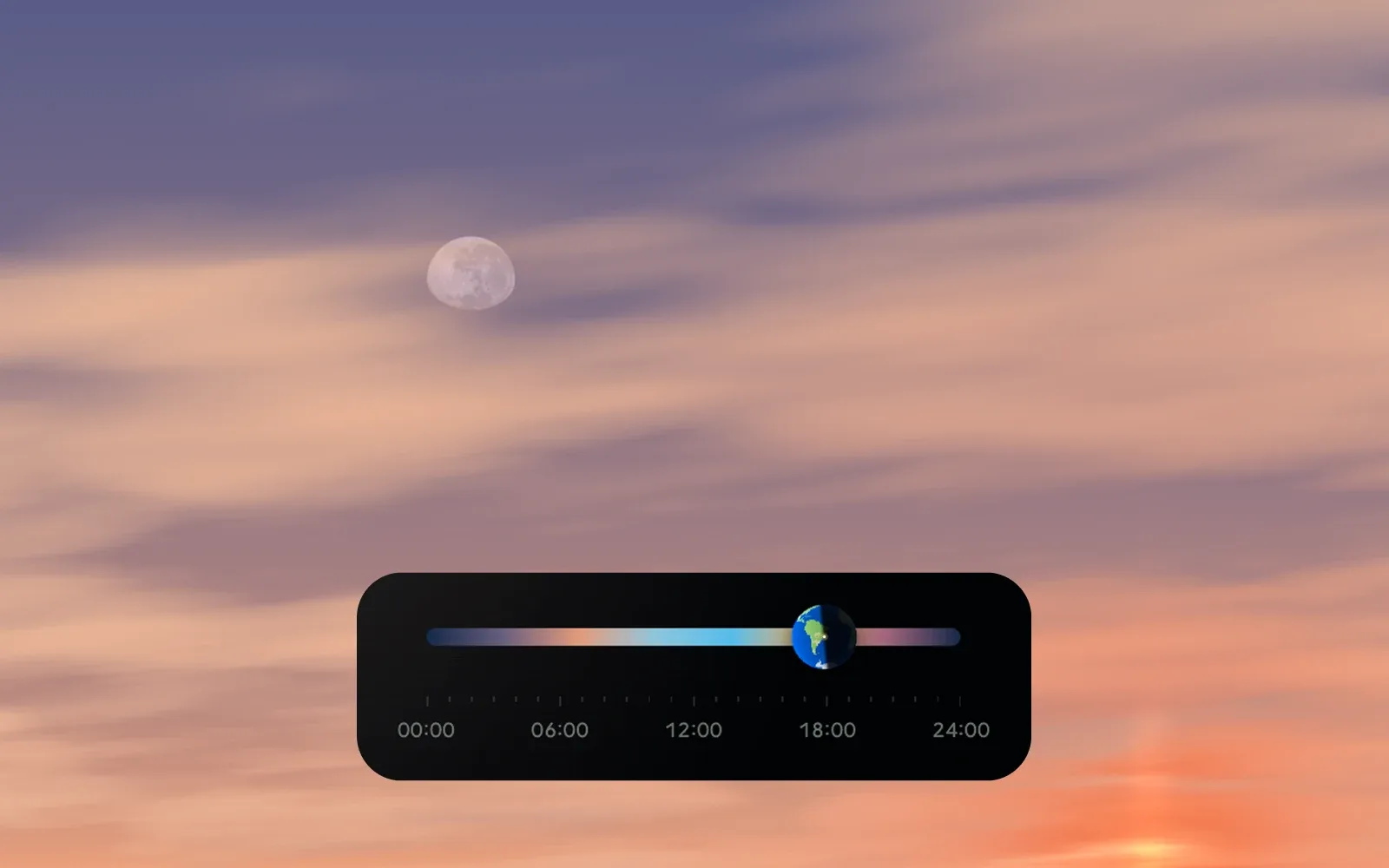
How it works
- Pick a place: search any city or region, or use your location.
- Set the time: the timeline shows today's daylight, twilight and night for that place. The Sun's position comes from SunCalc.
- Keep Auto on to draw that hour's forecast clouds and haze, or turn it off and set them yourself.
- Save it as a PNG, JPG or layered SVG, or record a video as the light changes.
Twilight, step by step
| Sun's height | What the sky does |
|---|---|
| 6° to −4° | Golden hour: warm, low light and long shadows on the clouds |
| 0° to −6° | Civil twilight: the Belt of Venus and the Earth's shadow rise in the east after sunset |
| −4° to −6° | Blue hour: deep, even blue light |
| −6° to −12° | Nautical twilight: the brightest stars appear; noctilucent clouds can shine in summer at high latitudes |
| −12° to −18° | Astronomical twilight: the last glow fades and the aurora can show |
Sunset phenomena you can add
- Green flash: a green rim on the Sun's top edge at the moment it sets.
- Crepuscular rays: beams of light and shadow fanning out from behind broken cloud.
- Sun pillar: a column of light above the low Sun, reflected by ice crystals.
- Belt of Venus and Earth's shadow: the pink band and the blue-grey band opposite the sunset.
In Auto mode each one appears only when the Sun's height and the cloud allow it.
Haze, dust and smoke
Haze follows hourly aerosol data. Desert dust turns the sky beige and the Sun pale, wildfire smoke turns it amber and the Sun deep red, and ordinary smog stays near white. Summer brings a higher Sun, longer days and a brighter, hazier horizon; winter a lower Sun and a pale steel-blue sky.
Frequently asked questions
How do I see what the sunset will look like in a particular place?
Open Sky Studyo, search for the place and drag the time to sunset. The Sun sits where it really will be today, and in Auto mode the clouds and haze come from that hour's forecast.
When is golden hour and blue hour?
Golden hour is roughly while the Sun is between 6 degrees above and 4 degrees below the horizon, just after sunrise and before sunset. Blue hour follows at sunset and comes before sunrise, while the Sun is about 4 to 6 degrees below the horizon. How long each lasts depends on latitude and season.
Why are sunsets red and orange?
Low sunlight crosses much more air. Air scatters blue light out of the beam on the way, so the light that reaches you, and the clouds it lights, is yellow, orange and red.
Why does wildfire smoke make the Sun red?
Smoke particles absorb and scatter short wavelengths, so the sky turns amber and the Sun deep red. Desert dust turns the sky beige and the Sun pale, while ordinary smog stays near white. Sky Studyo's haze follows hourly aerosol data, so it shows these differences for the place you choose.
What is the pink band above the horizon after sunset?
That is the Belt of Venus: sunlight scattered back from the upper air, sitting above the blue-grey shadow of the Earth rising in the opposite sky. It shows while the Sun is between about 1.5 and 6 degrees below the horizon.