Aurora simulator: the northern and southern lights in your browser
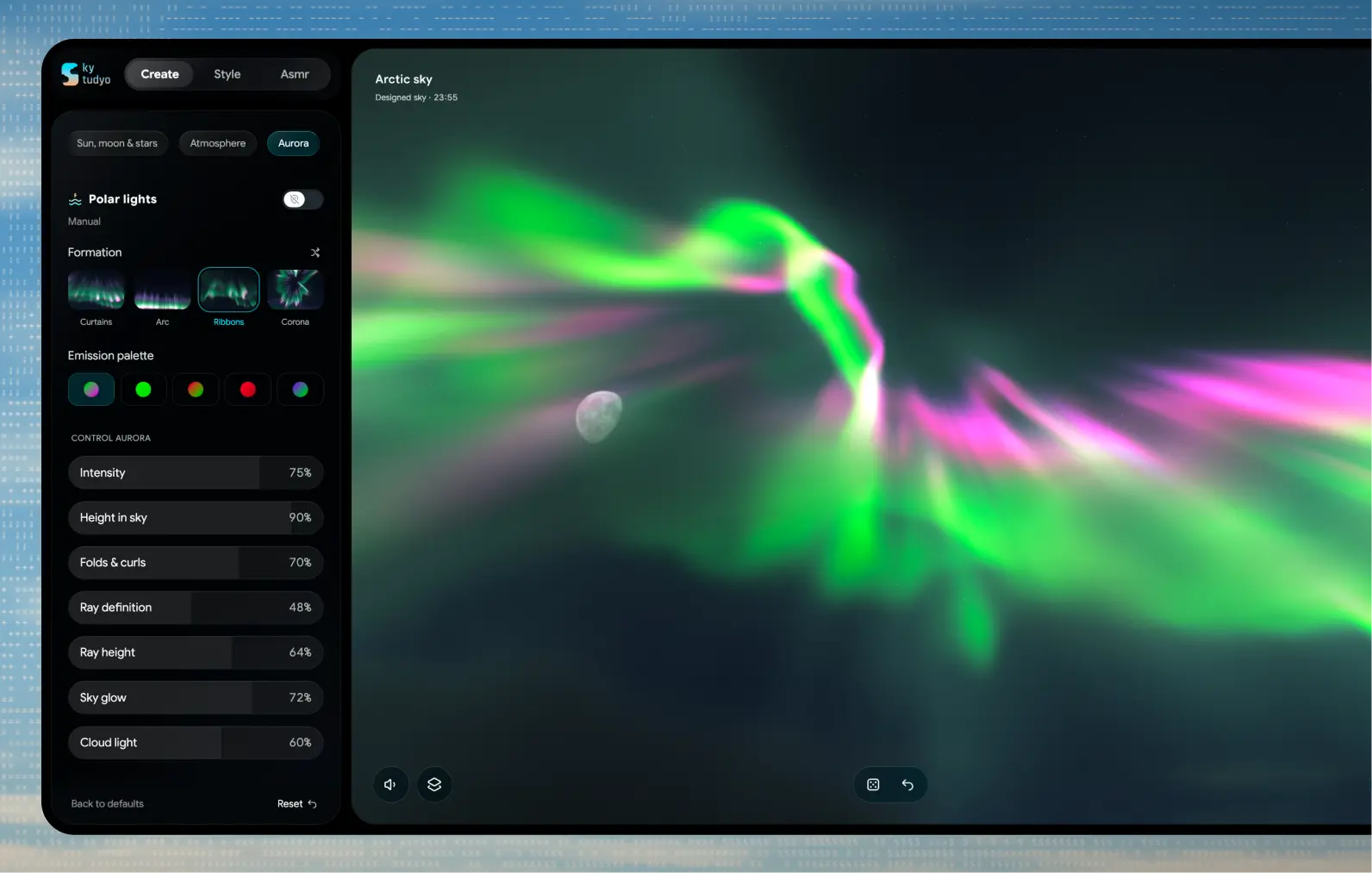
Sky Studyo's aurora simulator draws the northern lights (aurora borealis) or southern lights (aurora australis) over any place on Earth. In Auto mode it follows NOAA's live geomagnetic activity and the darkness of the sky; by hand you can set the form, height, colour and strength yourself.
How it decides whether a place sees the aurora
Auto mode uses three facts and nothing else:
- Geomagnetic activity: the planetary Kp index from the NOAA Space Weather Prediction Center, a 0–9 scale averaged over three hours.
- The place's geomagnetic latitude: its distance from the magnetic pole, which is not the same as its ordinary latitude. Reykjavík and Yellowknife both sit near 69° geomagnetic.
- Darkness: the Sun must be at least 12° below the horizon.
The auroral oval's equatorward edge is placed at 68 − 2.2 × Kp degrees of geomagnetic latitude:
| Kp | Oval reaches down to (geomagnetic) |
|---|---|
| 0 | 68.0° |
| 3 | 61.4° |
| 5 | 57.0° |
| 7 | 52.6° |
| 9 | 48.2° |
Inside the oval, the status line reads, for example, Northern Lights · inside the auroral oval · likely curtains · Kp 3.2 (3-hr avg). Outside it, it shows the place's geomagnetic latitude and the Kp it would need.
Four aurora forms
Arc: a quiet band, often the first sign of the evening 
Curtains: folded sheets hung with vertical rays 
Ribbons: bands that wind and fold across the sky 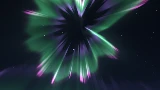
Corona: rays meeting overhead in a storm
Auto picks the likely form from the geomagnetic latitude, the local time and Kp, following the pattern of a substorm through the night. It is a well-informed guess, which is why the status line says "likely".
Eye colour or camera colour
The Intensity slider also sets how the colour is seen. A faint display looks as it does to the naked eye: pale grey-green with little red. A bright one is as vivid as in a long-exposure photograph, with saturated green, red above it, and violet where the rays reach sunlight.
Clouds and the aurora
The aurora glows 100–300 km up and every weather cloud sits below about 12 km, so the scene's real cloud is drawn in front of it, as dark shapes against the glow. A bright aurora shines through thin cloud and the gaps between cloudlets; an opaque deck shows only a soft glow, with no curtain or ray.
Frequently asked questions
Can the aurora simulator tell me if I will see the northern lights tonight?
No. It shows whether a place is inside the auroral oval for the current Kp index, which is a three-hour planetary average. Real visibility also depends on cloud and on short bursts of activity that Kp misses. For planning, use NOAA's Space Weather Prediction Center aurora forecast.
What Kp index do I need to see the aurora?
It depends on your geomagnetic latitude, not your ordinary latitude. Sky Studyo places the oval's equatorward edge at 68 minus 2.2 times Kp degrees of geomagnetic latitude: 68 degrees at Kp 0, 61.4 at Kp 3, 57 at Kp 5 and 52.6 at Kp 7. Outside the oval, the status line says which Kp the place needs.
Why does the aurora look pale to the eye but vivid green in photos?
In dim light the eye sees mostly with rod cells, which do not see colour, so a faint aurora looks grey-green and its red is hard to see. A camera collects light over several seconds and records the full colour. In Sky Studyo, a low Intensity shows the aurora as the eye sees it and a high Intensity shows it as a camera does.
What gives the aurora its colours?
Oxygen atoms glow green at 557.7 nanometres and, higher up, red at 630 nanometres. Nitrogen ions add violet-blue at 427.8 nanometres, strongest where the tops of the rays reach sunlight.
Does it show the southern lights too?
Yes. Choose a place in the far south, such as Tasmania, southern New Zealand or Antarctica, and the status line reads Southern Lights.